Research
Spoken English is silently costing Hong Kong Companies millions
July 2, 2026 · 12 min read

The hidden cost of poor English is real, not a soft skill. For a 500–1,000-person Hong Kong firm, our model estimates the loss at HK$6.65M to HK$13.1M a year, depending on the industry. Most of it stays invisible, because most interviewers assess their English capabilities based on feeling, not specific criteria. When a trained examiner grades the speaking instead, about two-thirds of the cost can be recovered. It never reaches zero. But it becomes much smaller.
We have all experienced the deep pride of welcoming brilliant talent to our teams—individuals whose outstanding qualifications and resumes promise immense potential.
Yet, navigating conversations in English can sometimes reveal unexpected hurdles, such as a brief moment of hesitation or a misunderstanding on a crucial client meeting. When an important client starts looking confused in a meeting, our natural instinct as supportive leaders is to step in, lend our expertise, and smoothly steer the conversation back on track.
Because we are fully focused on delivering exceptional results and supporting our people, it is completely natural that we overlook our staff's challenges when it comes to spoken English capabilities in workplace conversations. In this post, let us explore a helpful framework that honors the hard work of Hong Kong's business leaders while offering a clear, constructive way to visualize and understand these subtle operational patterns.
The hidden cost of poor English you never see
When we look closely at how our organizations thrive, we find wonderful opportunities for growth in the most fascinating places.
Our dedicated research and development team recently spent months building an insightful model to answer a vital question: how can we best understand the annual impact of spoken English fluency in a dynamic market like Hong Kong? For an outstanding firm of 500 to 1,000 professionals, the collective potential value is remarkably significant—reaching into the millions each year.
Understandably, this isn't something that readily shows up on a standard balance sheet. There is never a line item for "a missed opportunity to truly connect with a client on a complex call". Instead, these moments subtly weave themselves into overall project timelines, win rates, and the learning curves of our hardworking teams. Because every great leader handles a multitude of daily operational adjustments, it is easy to view these instances as standard business variations. However, by gently bringing this data into view, we unlock a wonderful opportunity to support our teams and elevate our shared success.
Let's explore together where these insights come from, how they relate beautifully to your specific industry, and how we can work together to capture this value.
Spoken English is not written English
It is completely understandable why so many excellent organizations rely on traditional screening methods; evaluating written skills is simply the most practical tool readily available to us.
An impressive CV, an articulate email, or a structured written test are wonderful indicators of a candidate's literary capabilities. However, as we all know, spontaneous dialogue with an expectant client presents an entirely different, more dynamic challenge.
This unique nuance is well-documented in our vibrant city. According to the 2025 EF English Proficiency Index, Hong Kong boasts an exceptional reading score of 550, while its speaking score sits at 494 — the lowest of its four skills. This highlights a wonderful truth: Hong Kong's professionals possess brilliant reading and writing faculties, and spoken confidence is simply the next frontier of growth.
A valuable workplace-language survey by the University of Hong Kong echoes this reality, showing that while 92% of local professionals feel entirely confident in spoken Cantonese, about 42% rate their spoken English at a similar level. Given that nearly 40% of our city's dedicated workforce operates in roles where cross-cultural communication is vital—including managers, professionals, and support staff (2021 Census)—bridging this speaking gap becomes a shared journey toward excellence. This is an industry-wide opportunity rather than a reflection on your talented team, and by addressing it collaboratively, we can give our professionals the exact tools they need to hire talent that shine in front of clients.
Why this cost stays hidden
This hidden impact persists for a very practical and honest reason: during the standard conversation-based or technical interview, while there are carefully curated criteria for cultural and technical fit, the criteria for spoken English is simply a subjective feeling.
It is worth pausing here, because this is not a criticism of the interview itself. A thoughtful interview is a genuinely wonderful place to hear how someone really speaks. A technical interview is better still: when you ask a candidate to work through a problem out loud and explain their reasoning, you hear their spoken English exactly where it matters—unscripted, under real pressure, in the middle of a difficult idea. The conversation is the right vehicle. It is doing its job beautifully.
The gap opens at the very next step: how that spoken English is scored. For technical ability, you already hold a clear standard—did the reasoning hold up, was the approach sound? For cultural fit, you have defined signals your team has agreed on together. You would never settle either of those on a feeling alone, because you know how much a wrong call can cost. And yet spoken English—which shapes every client conversation just as directly—is usually left to a warm, general impression at the end of the meeting.
Two gentle but expensive things follow from grading a skill on feeling.
The first is inconsistency. When the standard lives quietly in each interviewer's head rather than on the page, the very same candidate can clear the English bar with one interviewer and fall just short with another. Their English did not change—only the yardstick did. Researchers have measured this precisely. Because interviewers who rely on impression so often disagree with one another, an unstructured interview has a natural ceiling on how well it can predict real performance: about 0.34 on a scale from 0 to 1, where 1 is perfect (Conway and colleagues, 1995). Give those same interviewers a shared, structured standard to score against, and that ceiling nearly doubles, to about 0.67. The conversation stayed the same. Only the way it was scored improved.
The second is simple reliability. A large 2022 review by Sackett and colleagues measured how well different hiring methods predict future performance, again on that 0-to-1 scale. A judgement built on impression sits at around 0.19. The very same interview, scored against an established standard, rises to about 0.42—more than double. Set criteria are not extra paperwork. They are the quiet difference between a lovely conversation and a measurement you can genuinely rely on.
Spoken language is also unusually easy to misread by feeling, because warmth and confidence are so persuasive. In a well-known study, Lev-Ari and Keysar (2010) found that listeners quietly rated the very same factual statement as less believable when it was spoken with a stronger accent—the words identical, only the sound different. It is an involuntary, entirely human response that touches all of us, including our clients and our most experienced interviewers. A shared rubric is simply the kind, fair-minded way a team protects a good candidate from that drift, in both directions.
So when a warm, genuinely capable candidate shines in an interview, that is a real and valuable signal—of charm, of rapport, of quick thinking. It is simply not yet a measurement of how clearly they will speak with a client three weeks later. If a difficulty appears on that first live call, it is never a reflection of your team's judgement. It is what naturally happens when the one skill you most need in front of clients is the only one you were scoring on a feeling—and that, happily, is a very fixable thing.
The cost, by industry
Here is what it costs. It is higher when each employee is responsible for more money.
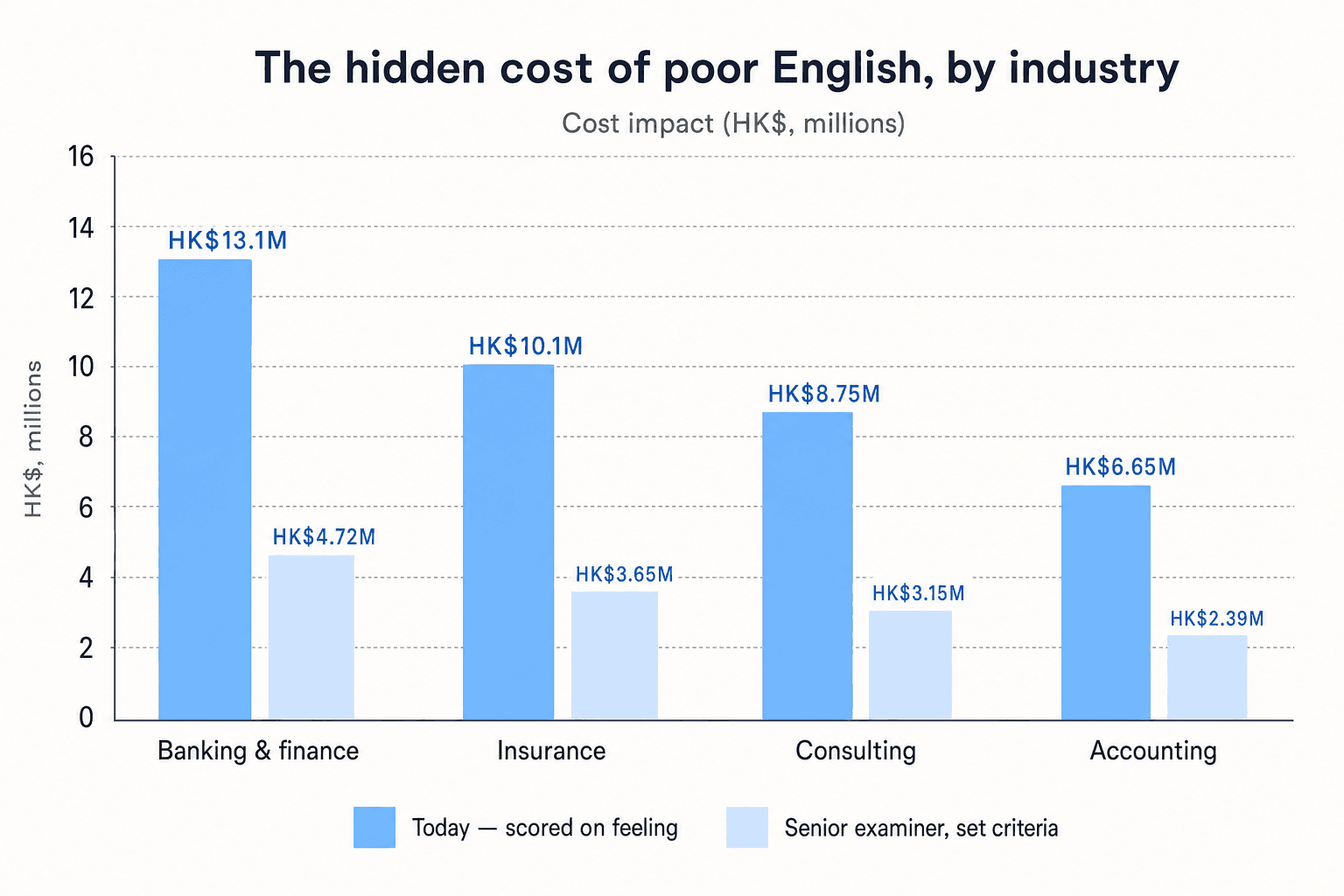
We mapped these insights across a standard 500–1,000-person Hong Kong firm across four vital sectors, exploring how clearer, more consistent assessment can uplift daily client interactions.
| Industry | Cost today (English scored on feeling) | With English scored against set criteria | Recovered each year |
|---|---|---|---|
| Banking & finance | HK$13.1M | HK$4.72M | ~HK$8.4M |
| Insurance | HK$10.1M | HK$3.65M | ~HK$6.5M |
| Consulting | HK$8.75M | HK$3.15M | ~HK$5.6M |
| Accounting | HK$6.65M | HK$2.39M | ~HK$4.3M |
Banking and finance naturally reflect the highest figures because each talented professional in this sector guides substantial transactions—averaging a value-added contribution of about HK$2.7M annually, compared to roughly HK$0.5M in professional services. When a client conversation goes well, it beautifully safeguards these critical relationships; when spoken English is misjudged at the hiring stage, more revenue sits at risk per person.
Our model allows you to tailor these inputs to reflect your unique organizational reality, accommodating company size, specialization, and the specific client-facing demands of your team.
Rather than stemming from major disruptions, these figures represent the gentle accumulation of minor everyday friction points that clearer assessment can easily help resolve:
- opportunities to build even deeper, more convincing client relationships on introductory calls
- ways to make meetings more streamlined and time-efficient for busy teams
- ensuring senior leaders can focus on high-level strategy rather than stepping in to assist with communication adjustments
- reducing team turnover by ensuring the right fit and support from day one
Want the full method? Every source, every assumption, and the complete model behind these figures. We show every step of the calculation, including the parts we are least certain about.
How much you can save each year
The wonderful news is that these figures represent an open door for optimization and empowerment—and the change that opens it is smaller than you might expect.
You do not need to replace the interview. You simply need to score the spoken English inside it the same careful way you already score technical ability and cultural fit: against a clear, shared standard, by someone trained to apply it. When a certified senior examiner evaluates spoken English against an objective rubric, that single step refines your initial screening and gently guides the variance in candidate communication from 21% down to 8%. Across all four industries, this one positive adjustment can help your firm recover roughly two-thirds of these localized costs annually—reinvesting approximately HK$8.4M for financial institutions and HK$4.3M for accounting firms back into your business.
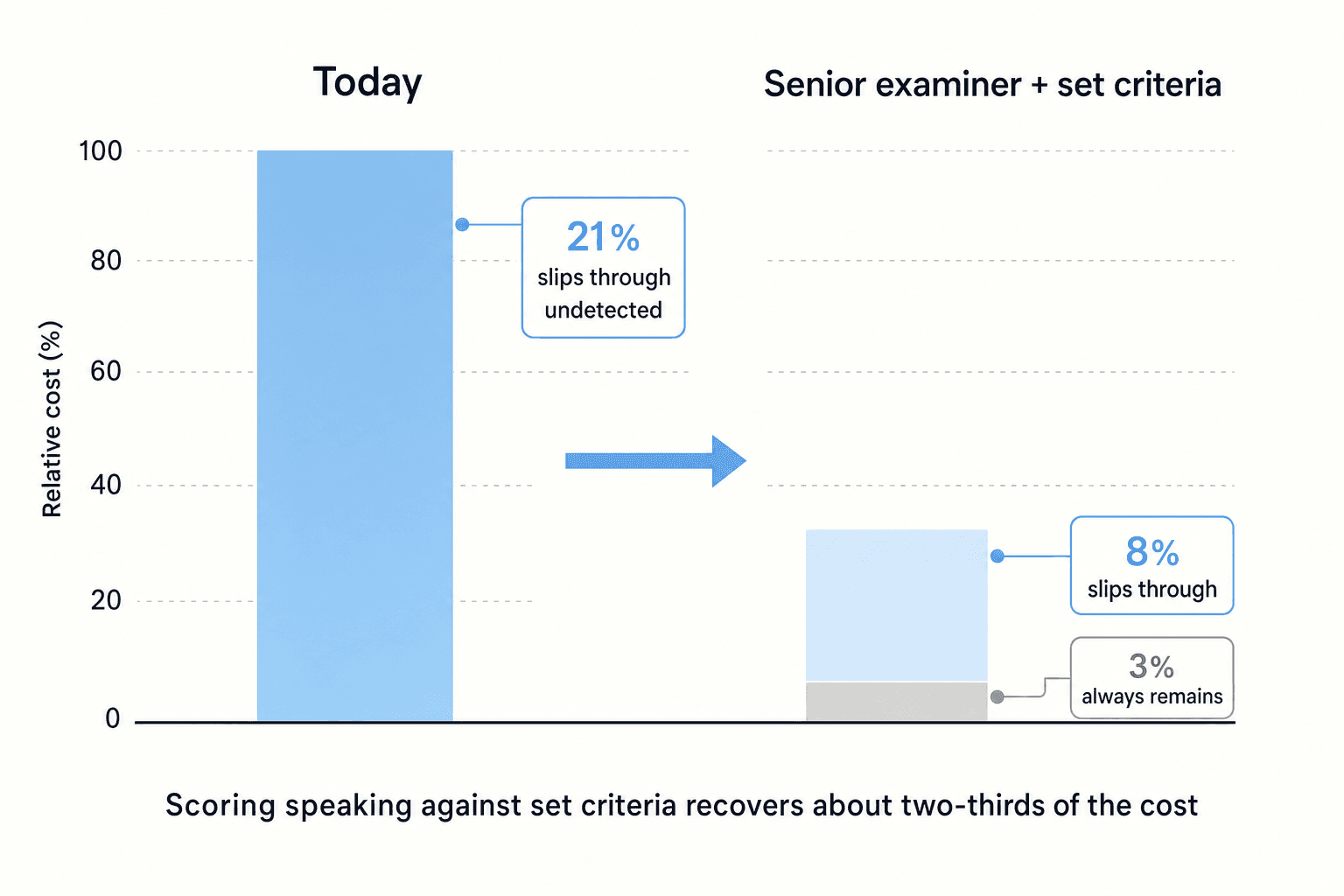
This achievement is a celebration of structured, compassionate evaluation. It is also exactly what set criteria do for any skill. When researchers Sundqvist and colleagues (2020) gave raters a shared rubric for spoken English, the agreement and reliability of their scores rose beautifully from 0.58 to 0.83—moving from "fair" to "excellent". A trained examiner with a rubric and a manager working from a warm impression are not doing the same job at all. One measures. The other, kindly and honestly, guesses.
Investing in this foresight is also wonderfully gentle on your budget. At approximately HK$1,300 per candidate—well within the standard cost of an IELTS evaluation in Hong Kong—this small measure provides immense peace of mind. It allows you to proactively nurture your team, which is far more efficient than post-hire training programs that typically range from HK$5,000 to HK$32,000 per person and require months of intensive effort.
It never reaches zero — and that is the honest promise
In the spirit of complete transparency and mutual respect, we believe it is vital to acknowledge that no process is entirely flawless. Any tool that promises you can remove this cost completely is not being honest with you.
Even with the most sophisticated, caring assessment strategies, a baseline variation of around 3% will naturally remain. Human beings are wonderfully complex; we all have days where we perform beautifully and days where we face fatigue, and a single assessment can never capture every facet of a professional's lifelong journey.
Our sincere commitment to you isn't an unrealistic promise of absolute perfection. Rather, it is a pledge to help you substantially smooth the path ahead, turning a hidden organizational challenge into an empowering, highly manageable strategy for long-term growth. Going from a HK$13.1M problem to a HK$4.72M one does not solve everything. It solves most of it — and it turns an invisible cost into one you can manage.
The one thing to remember
Spoken communication is a profound asset that directly nurtures corporate success and strengthens client trust.
- For mid-sized firms in Hong Kong, maximizing this fluency unlocks millions in value annually, particularly within the bustling banking and finance sectors.
- Your interview is the right place to hear spoken English—especially a technical interview, where candidates think out loud. The opportunity is not to change the conversation, but to score it against set criteria, exactly as you already do for technical ability and cultural fit.
- Scoring speaking against a clear standard—rather than a warm feeling—helps capture approximately two-thirds of this hidden value each year, and keeps the answer consistent no matter who is in the room.
- While no method can promise absolute perfection, every step closer to clarity brings extraordinary rewards for your organization.
By bringing these insights into the light, we can work together to foster a workplace that thrives on clear, confident connection. We would be absolutely delighted to help you discover the unique potential awaiting your specific organization.
Enter your own numbers and see the figure, and the breakdown, in under two minutes.
Frequently asked questions
What is the "hidden cost of poor English"? It represents the wonderful opportunity for growth when we refine spoken communication within our teams. When language barriers cause minor day-to-day friction—such as extended project timelines, additional supervisory support, or client alignment adjustments—it gently impacts overall operational efficiency. Bringing visibility to this area helps us lift these hidden weights and set our teams up for seamless success.
Why spoken English, and not written English? Our professionals in Hong Kong are exceptionally talented writers and readers, as reflected in their stellar educational backgrounds and resumes. However, engaging in spontaneous, high-pressure client dialogue is a distinct interpersonal skill. Since spoken confidence is a unique growth area across the region, focusing on it allows us to give our teams the precise support they need where it matters most.
Isn't a good interview already enough to judge spoken English? The interview itself is excellent—it is the right conversation, especially a technical one where a candidate reasons out loud. What varies is the scoring. When spoken English is judged on a general impression rather than a shared standard, the same candidate can pass with one interviewer and fall short with another. Adding set criteria keeps the interview exactly as it is, and simply makes the result consistent and reliable—the same rigor you already trust for technical ability and cultural fit.
How is the cost calculated? The model honors the specific context of your organization by combining your firm's size, industry focus, and client engagement levels with reliable regional salary data and respected workplace communication studies. Every single element of the calculation is fully adjustable because we respect that no one understands your unique business better than you do.
Can the cost really reach zero? In an authentic human environment, perfection is rarely the goal. We naturally anticipate a modest baseline variation of about 3%, which honors the natural ebb and flow of daily human performance. The true victory lies in significantly reducing friction and empowering your exceptional team to communicate with absolute confidence.
By BEST · Research
- hidden cost of poor English
- spoken English
- business English skills gap
- English training Hong Kong
- Hong Kong
- hiring
- workplace communication
- senior examiner
Keep reading
View all →
Research · 11 min read · Jun 22, 2026
English Soft Skills
English soft skills decide who can really speak with a client. Learn what interactive communication is, why it matters, and get a free rubric to score it.

Research · 7 min read · Jun 6, 2026
Assessing English Skills in the Age of AI
AI can now write better than most people, so a written English test measures tool access, not ability. The signal that still works is live, spoken English.

Research · 7 min read · Jun 6, 2026
Agile Spoken English
Stop hiring for "fluent." Start hiring for agile spoken English.