Research
Assessing English Skills in the Age of AI
June 6, 2026 · 7 min read
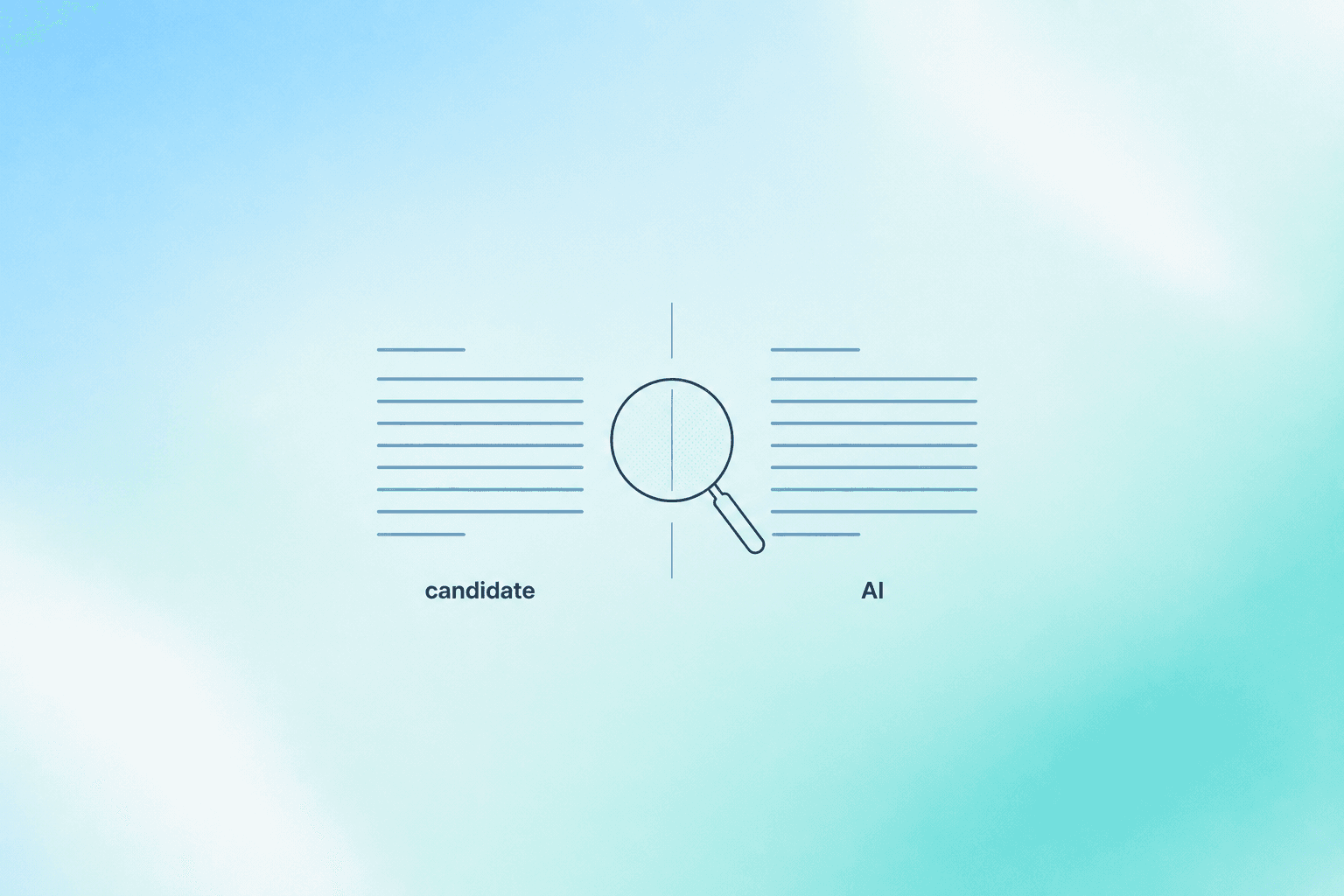
Nearly 3 in 10 job seekers now use AI to write their resume. A year earlier, it was fewer than 1 in 6 (iHire, 2025).
So here is the problem for anyone who hires. You judge a candidate's English by what they write — a CV, a cover letter, a written test, an email. That used to tell you something real. It does not anymore.
This is the core challenge of assessing English skills in the age of AI. A written sample no longer shows you the person. It shows you the tool they used. By the end of this post, you will know two things. First, you will know why reading and writing no longer measure real language ability. Second, you will know which signal still works.
TL;DR. AI can now write, rewrite, and explain text better than most people. So a written or reading-based English test measures who has the tool, not who has the skill. The one thing AI cannot do is speak for a candidate in a live, unscripted conversation. So spoken English, produced live and without help, is the clearest sign of real skill that remains.
You do not need to do anything about this today. But you should understand it before your next hire. Keep reading.
Reading and writing stopped testing the person
Start with what you actually collect. Almost every English check in hiring is a written one.
The CV is written. The cover letter is written. The take-home task is written. Even the "quick email to see how they write" is written. For years, that was fine. Writing was a fair window into someone's language ability, because the candidate produced it alone.
That window is now open to everyone with a browser. People use AI to write at work, not just to get hired. Among workers who use AI on the job, 47% use it to draft reports and documents, and 52% use it to edit written content (Pew Research Center, 2025). Another study measured real published text. By late 2024, up to a quarter of corporate press releases already showed signs of AI help (Liang et al., Patterns, 2025).
So the written sample you read is no longer the work of one person. It is the work of two. And you cannot tell which voice is which.
AI now writes better than most people
Here is the part that breaks the test completely. AI does not just write. It writes well.
In a controlled study in Science, ChatGPT cut the writing time of professionals by 40%. It also raised the quality of their work by 18%. Other professionals graded the work without knowing who wrote it (Noy & Zhang, 2023). A separate blind study found the same pattern. Teachers scored AI-written essays at 4.68 out of 6, against 3.69 for human essays. The AI beat people on every measure, and the biggest gap was in language itself (Herbold et al., Scientific Reports, 2023).
AI is not flawless. On strictly graded analytical essays it stays around average, not top of the class. But a CV or a work email is not an analytical essay. It is everyday business writing. For that kind of writing, blind studies place AI at or above the typical person.
Think about what this does to your signal. A weak writer with AI now reads as a strong writer. A strong writer with AI reads the same. The text rises to meet the tool, so it stops telling you about the person.
A written test now measures tool access, not ability
Put the two facts together, and the conclusion is hard to avoid. When AI writes for free, a written English score shows who used AI. It does not show who can use English.
The data on testing makes this clear. In a real blind trial, AI-generated exam answers passed the markers 94% of the time. On average, they even scored higher than answers from real students (Scarfe et al., PLOS ONE, 2024). Your written test is not just easy to beat. It rewards the candidate who relies on the tool most.
The table below shows how this affects the written signals you rely on.
| Written signal you collect | What the data shows |
|---|---|
| Resume and cover letter | 29.3% of job seekers used AI to write them in 2025, up from 17.3% the year before (iHire) |
| Work emails, reports, documents | Among workers who use AI, 47% draft and 52% edit written content with it (Pew) |
| Take-home or online written test | AI answers went undetected 94% of the time and scored higher than real students (PLOS ONE) |
The scale is also moving fast. LinkedIn now receives around 11,000 applications every minute. That is more than 45% higher than a year ago. LinkedIn links this jump in part to AI tools (reported by The New York Times, 2025). You get more polished applications, but less signal in each one.
This is the quiet cost. You hire someone based on a written score that looks strong. The gap appears later, in the work itself. It often appears in a live conversation, where the candidate cannot get outside help.
The one thing AI cannot do: speak for someone
So what is left? Find the channel where AI cannot replace a person. There is one. AI cannot speak for a candidate in a live, unscripted conversation.
It can write the email before the meeting. It cannot sit in the meeting. It cannot answer the question a client asks in the moment. It cannot keep arguing its case when someone disagrees. It cannot think out loud while the room waits. That has to be the person, in real time, with no tool to help.
This matters more because writing skill never showed you a person's speaking skill anyway. One peer-reviewed study found the link between a learner's writing skill and their speaking skill was almost zero. The correlation was just 0.08 (Rahman & Suryanto, 2022). Even across the big standardised tests, speaking and writing scores match only in part (ETS concordance research). A strong writer can be a weak speaker. You were never reading one skill from the other.
And speaking is the skill employers actually want. Communication was the most wanted skill on LinkedIn in 2024, for the second year in a row (LinkedIn, via Axios, 2024). For senior, client-facing roles, raw proficiency is not enough. The job is live talk.
How to assess English skills in the age of AI
The fix is not to police AI out of your written tests. That is a losing race; detection already fails far more often than it works. The fix is to assess the thing AI cannot fake for someone.
That means a live, spoken check. Not a rehearsed presentation, which a candidate can prepare with AI the night before. You want a short, unscripted speaking task. The person has to think and respond in real time. When the script is gone, the tool is gone too. What is left is the candidate's own English.
You do not need a platform to start, and you do not need much time. A few minutes of unplanned conversation show more real ability than a written test that anyone can now pass. The next question is the practical one: what spoken skill should you measure, and how do you run the task so it is fair and repeatable? That is exactly what the next post covers.
FAQ
Can you still trust a written English test when hiring? Less than before. AI can write and polish text better than most people. AI-written answers pass most markers most of the time. A written score now shows tool access as much as ability.
Does strong written English mean strong spoken English? No. Studies find the two skills barely match. Writing gives a person time to plan and edit. A live conversation does not. You cannot read one skill from the other.
How should you assess English skills in the age of AI? Use a short, live, unscripted speaking task. Speech made in real time, with no tool in the gap, is the clearest sign of real ability. AI cannot fake it for the candidate.
Why is spoken English the signal that still works? Because AI cannot speak for someone in a real meeting. It can write the email first, but it cannot answer the surprise question live. That moment belongs to the candidate alone.
Isn't using AI to write a resume just being resourceful? For the candidate, yes. The problem is for the assessor. When everyone can make strong text, the text stops showing you who is strong. You need a signal AI does not touch.
The short version
- Nearly 3 in 10 job seekers now use AI to write their resume, up from fewer than 1 in 6 a year earlier.
- AI writes everyday text at or above the level of the average person, in blind studies.
- So a written or reading-based English test measures tool access, not ability. AI answers even beat real students and stay undetected 94% of the time.
- Writing ability never predicted speaking ability anyway. The two skills barely match.
- The one signal AI cannot fake is live, unscripted speech. AI cannot speak for the candidate in a real conversation.
- Assess English by listening, not reading. A few minutes of unplanned conversation beats a written test that anyone can now pass.
Next: which spoken skill to measure, and how to test for it.
By BEST · Research
- english assessment
- ai in hiring
- ai-generated resumes
- spoken english
- communication skills
- recruitment
- english speaking test
Keep reading
View all →
Research · 12 min read · Jul 2, 2026
Spoken English is silently costing Hong Kong Companies millions
Poor spoken English quietly costs Hong Kong firms millions a year. See the hidden cost of poor English by industry, and how a senior examiner recovers most.

Research · 11 min read · Jun 22, 2026
English Soft Skills
English soft skills decide who can really speak with a client. Learn what interactive communication is, why it matters, and get a free rubric to score it.

Research · 7 min read · Jun 6, 2026
Agile Spoken English
Stop hiring for "fluent." Start hiring for agile spoken English.