Research
Agile Spoken English
June 6, 2026 · 7 min read

TL;DR. At work, English speaking is mostly unplanned. So the skill that decides success is agile spoken English – the ability to think clearly and respond with confidence when a business conversation is unscripted. A CV, an email, and a rehearsed interview all hide this skill. A short, structured speaking task reveals it.
A Hong Kong company we spoke with had a hiring problem it could not see.
Its recruitment agency supplied candidates described as "fluent in English." However, in the office, the result was different. Line managers and HR kept finding the same problem. Many of these hires struggled in real client meetings.
This is the quiet failure of business English fluency. The word "fluent" sounds precise. It is not. It is a guess, not a fact.
By the end of this post, you will know why the "fluent" label keeps failing at work. You will also know what to measure instead: agile spoken English, the ability to articulate your thinking and respond with confidence in English in unplanned business conversations. We will show you why the old method of testing fluency doesn't work, what agile English is, and how to test for it yourself. By the end, you will stop looking for "fluent" talent and start looking for agile.
"Fluent" is a guess, not a measurement
Start with the word itself. "Fluent" has no fixed meaning.
To a recruitment agency, fluent is a sales word. To a candidate, it is one line on a CV. To a hiring manager, it is a feeling after a 30-minute interview. Three people. Three different scales. No shared standard.
So the problem appears later. You do not feel it in the interview. You feel it three weeks later, in a client call where your new hire can't articulate thoughts in an unplanned meeting with a client.
This is not a small-print problem. The hires most often described as "fluent" are the ones in the roles where spoken English matters most.
At work, English is spoken and unplanned
Here is what the "fluent" criteria forgets. Most spoken workplace English is unplanned.
Senior and client-facing roles need spoken English the most. They use English in live meetings with clients and partners, every day or every week. The pressure is rarely the prepared part. You can practise a presentation at home. The pressure is the unplanned part: the question you did not expect, the client who disagrees, the meeting that moves to an unexpected topic.
This problem only grows. As a company wins more global clients, the live conversations multiply. More unscripted moments. More cost when someone cannot respond well. The skill you test for when hiring decides how the business performs in its most important meetings.
Agile spoken English
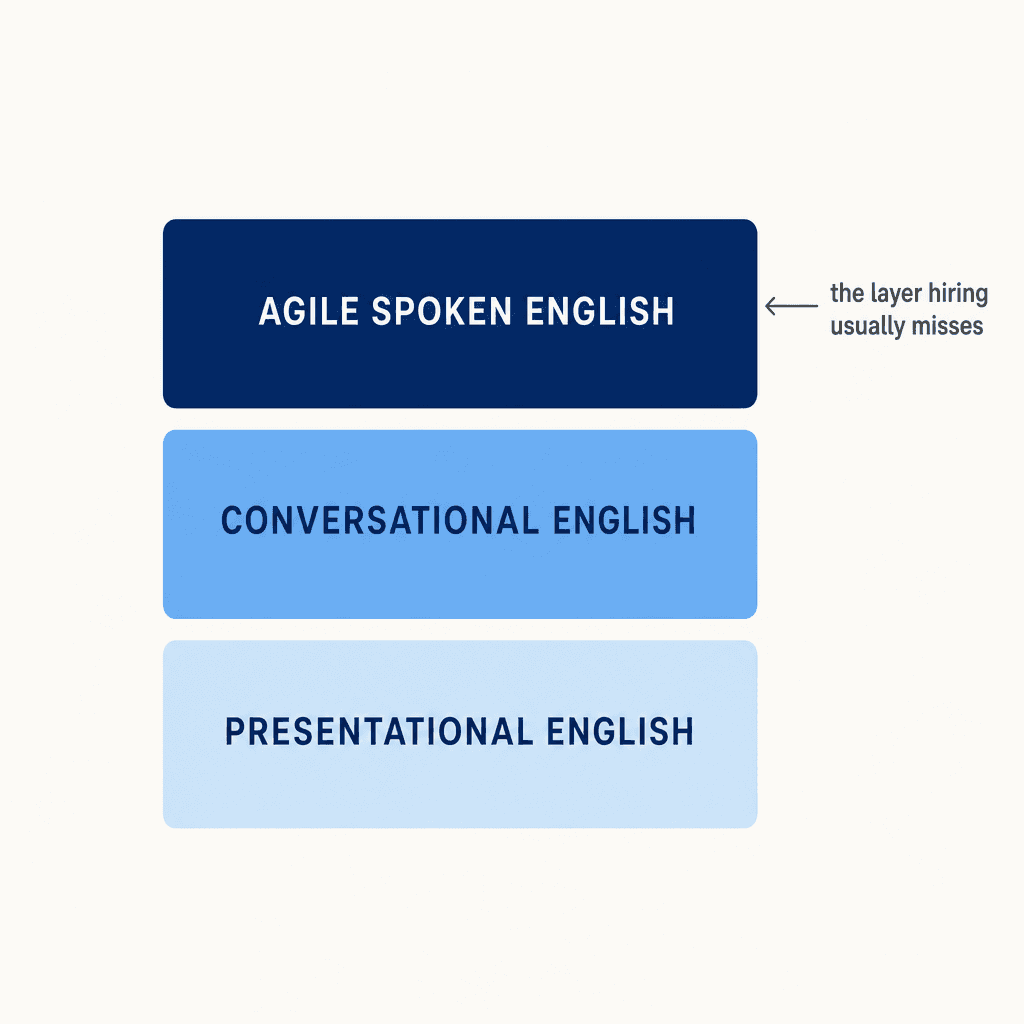
So measure the right skill. We call it agile spoken English.
Agile spoken English is the ability to articulate your thinking and respond with confidence in English when a business conversation is unplanned or unscripted.
It builds on two skills people already know:
- Presentational English. Prepared, rehearsed, one-way. A talk you practised.
- Conversational English. Two-way talk on familiar topics. Casual chat, routine updates, predictable questions.
- Agile spoken English. The dynamic layer. Thinking as you speak, handling the unexpected, articulating clearly when there is no script.
Most hiring screens test the first layer and assume the other two are there too. They do not. A candidate can give a polished, rehearsed answer and still struggle the moment an unexpected question is asked. Workplace fluency is not how well someone speaks when they are ready. It is how well they speak when they are not.
This is the thing to hire for. Once you name it, you notice it everywhere. You stop asking "are they fluent?" and start asking "are they agile?"
A quick note before we continue: there is a simple exercise that exposes this gap in about five minutes. We share it free at the end, with no sign-up.
Why a CV, an email, and an interview all miss it
Every common screen measures the rehearsed layer. None of them measures agility.
| What you use | What it shows | What it hides |
|---|---|---|
| "Fluent" on a CV | A self-claim | Almost everything |
| A written email exchange | Written grammar and vocabulary | Live, spoken ability |
| An agency endorsement | Claims of Fluency | Unqualified judgement |
| A standard interview | Prepared, predictable answers | Response to the unexpected |
| A short structured speaking task | Agile spoken English | Written English |
Read the table from top to bottom. Four of the five most common screens hide the exact skill the job needs. Only the last one shows it. The fix is not to interview harder. The fix is to interview for the unplanned.
What agility looks like when you test for it
You cannot rehearse what you cannot predict. That is the whole idea behind testing agility.
A good exercise removes the script. Give the candidate a short, real workplace situation. One minute to read it. Then do it live, in three parts.
- A role-play, with the roles reversed. The candidate has to lead the conversation and ask clear questions to find specific details. The assessor holds the facts and must not help. Vague questions get nothing. The candidate gets the details only when they ask for it well.
- An immediate follow-up question. Ask for an opinion with no time to prepare. Something like, "Do you think you can manage this?" Twenty seconds. No script.
- A short discussion. Open a broader question and discuss it. Something like, "What makes a good business partner?" One to two minutes of unscripted reasoning.
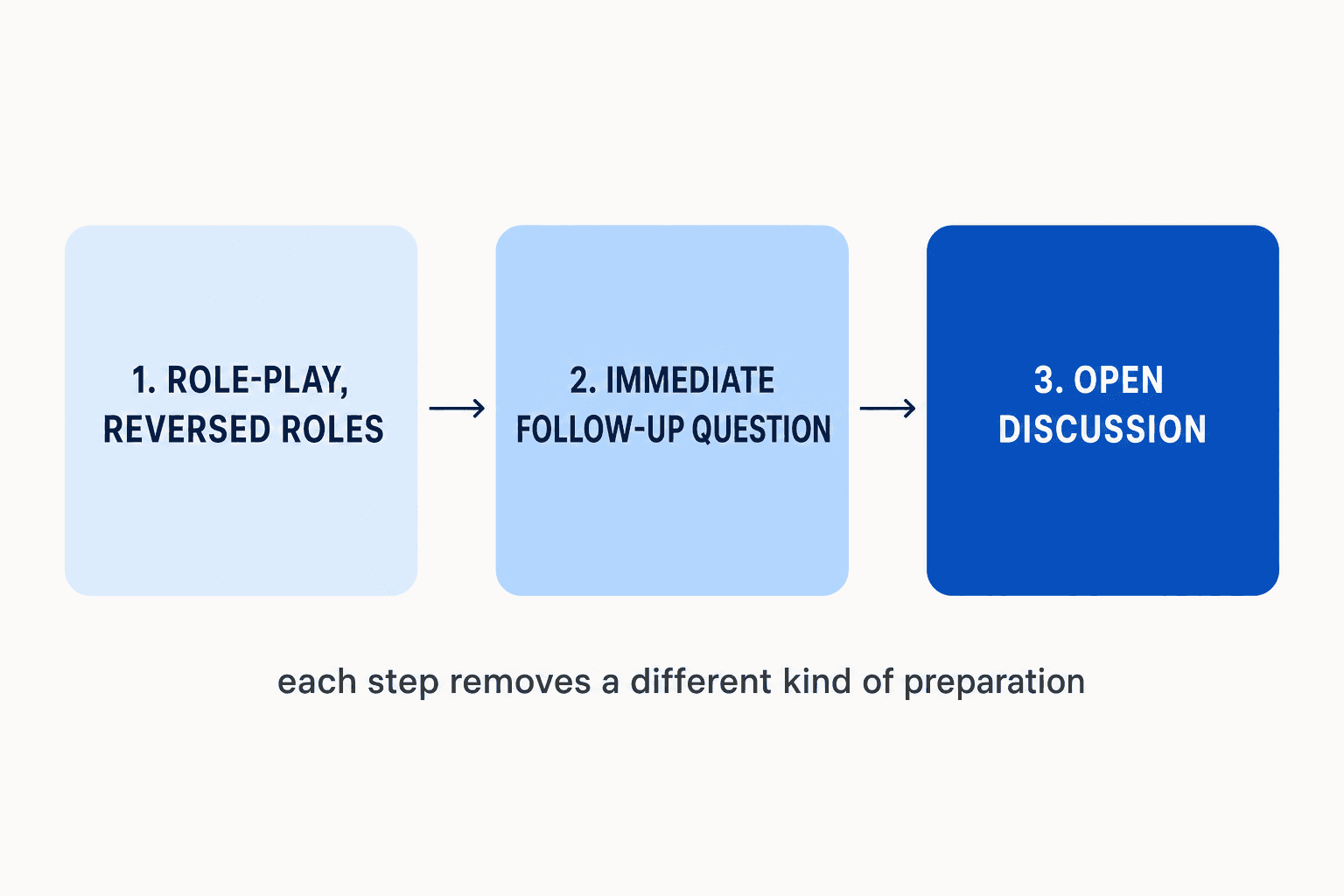
Watch what this reveals. Can they start a conversation? Can they ask the right question, not just any question? Can they listen, process, and respond in real time? Can they hold a short discussion when nothing is rehearsed?
A candidate who is "fluent on a CV" cannot fake this. The role-play removes the script. The follow-up removes the time to prepare. The discussion removes the safety of a single right answer. Either the agility is there, or it is not. You will see which in minutes.
This is also why unscripted business conversations demand more than vocabulary — the skill is not knowing the words, it is using them under pressure.
Three ways to test for agile spoken English in any interview
You do not need a platform to start. You can test for agility in your next interview today. Use three rules.
- Remove the script. Ask something the candidate could not have prepared. Skip "tell me about yourself." Try "a client just changed the requirements in the meeting. Tell me what you would say next."
- Reverse the roles. Make them lead. Give them a goal and some missing information, then have them ask you for it. Watch how they question, not just how they answer.
- Move to the unexpected. Change direction in the middle of an answer. Ask for an opinion. See whether they stay clear and confident when the conversation is no longer predictable.
Three rules. One aim. See the candidate think in English, live, when nothing is rehearsed.
Then change what you ask for. Tell your recruitment agency you are not looking for "fluent." You are looking for someone who can think and respond in English when the meeting moves to something unplanned. Put that line in the job description. Watch the shortlist change.
We have turned exactly this into a ready-to-use exercise. It is the full role-play, follow-up question, and discussion task, on one page. Take it into your next interview and use it as written.
FAQ
What does "fluent in English" actually mean at work? There is no fixed definition. "Fluent" is a self-claim or a feeling, not a measurement. At work, what matters is whether someone can speak and respond well in live, unplanned conversations.
Is spoken English fluency different from written English fluency? Yes. Strong written English does not prove strong spoken English. Writing gives you time to plan and edit. A live client meeting does not.
What is agile spoken English? Agile spoken English is the ability to articulate your thinking and respond with confidence in English when a business conversation is unplanned or unscripted. It is the skill most hiring screens miss.
How do you assess spoken English when hiring? Use a short, structured speaking task the candidate cannot rehearse. Remove the script, reverse the roles, and watch how they handle the unexpected.
Why do agency "fluent" labels fail so often? Because there is no shared standard behind them. One person's "fluent" is another person's "just okay." Without a structured spoken check, the gap only appears later, after they start work.
The short version
- "Fluent" is a label, not a measurement. It means something different to everyone.
- At work, English is mostly spoken and mostly unplanned.
- The skill that decides success is agile spoken English: thinking and responding with confidence when there is no script.
- A CV, an email, an agency endorsement, and a standard interview all hide it.
- A short, structured speaking task reveals it. You can start in your next interview.
- Change what you look for. Change what you ask for. Change what you write in the job description.
By BEST · Research
- english
- business
- fluency
- agile english
- business english
Keep reading
View all →
Research · 12 min read · Jul 2, 2026
Spoken English is silently costing Hong Kong Companies millions
Poor spoken English quietly costs Hong Kong firms millions a year. See the hidden cost of poor English by industry, and how a senior examiner recovers most.

Research · 11 min read · Jun 22, 2026
English Soft Skills
English soft skills decide who can really speak with a client. Learn what interactive communication is, why it matters, and get a free rubric to score it.
Research · 7 min read · Jun 6, 2026
Assessing English Skills in the Age of AI
AI can now write better than most people, so a written English test measures tool access, not ability. The signal that still works is live, spoken English.