Product
Keeping Online Test Integrity
June 7, 2026 · 11 min read
Quick answer. No online assessment can stop cheating 100%. The honest goal is to raise the cost of cheating and make attempts visible to a human reviewer. Browser-based tricks — second tabs, refreshes, second monitors, AI help — each have a specific counter. And one structural advantage beats them all: a real-time speaking test is far harder to fake with AI than a written one. You cannot copy and paste speech, and reading an answer aloud sounds unnatural.
No online assessment can stop cheating 100% — and any vendor who tells you otherwise is selling you something.
That is an uncomfortable way to start a post about how to prevent cheating in online assessments. But if you run hiring, you already feel the problem. You launched remote assessments to screen more candidates, faster. Then a hiring manager asked the question you could not fully answer: couldn't they just cheat?
This post gives you a straight answer. You will learn how candidates actually cheat in browser-based assessments, why "cheat-proof" is a marketing lie, and why a speaking-based test closes gaps a written one never can. The aim is not a magic shield. It is a process you can defend.
Cheating is now the default assumption, not the edge case
Start with the scale of the problem, because the numbers are worse than most HR teams assume.
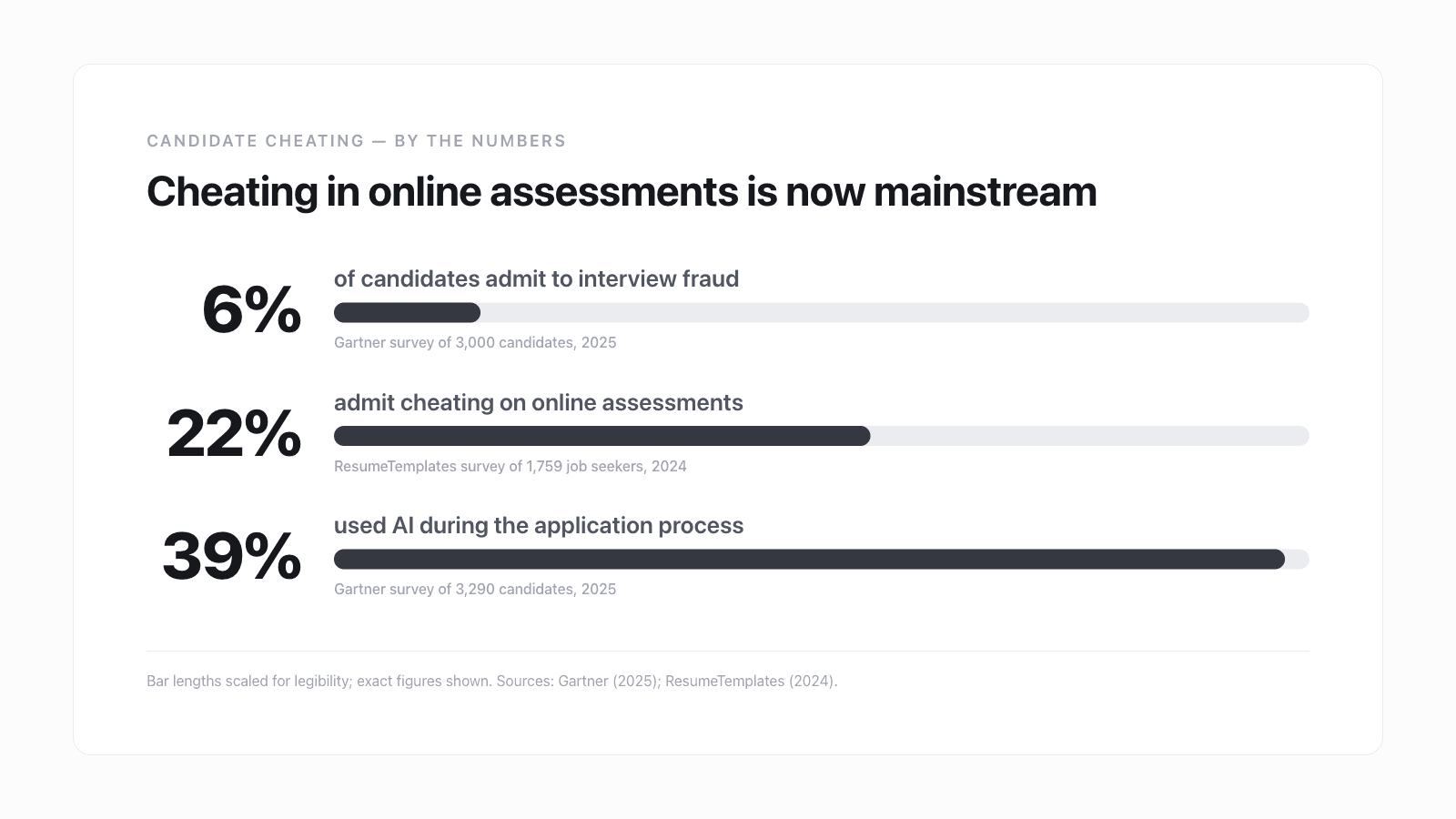
In a 2025 Gartner survey of 3,000 candidates, 6% admitted to "interview fraud" — pretending to be someone else, or having someone else pretend to be them. Gartner expects 1 in 4 candidate profiles to be fake by 2028 (Gartner, July 2025). A separate survey of 1,759 recent job seekers found 22% admitted cheating on online assessments specifically. Of those, 37% used ChatGPT and 21% had someone else complete the whole assessment (ResumeTemplates, May 2024).
AI made this easy. 39% of candidates now use AI during the application process — including on assessment questions (Gartner, 2025). And it works: in a peer-reviewed experiment, candidates who used ChatGPT in video interviews scored much higher than those who did not — while interviewers failed to fully catch them (Canagasuriam & Lukacik, International Journal of Selection and Assessment, 2025).
Consider that last finding. The cheating is effective and invisible to a human watching the interview. A faked score does not look faked. It looks like a strong candidate — until the new hire cannot do the job they tested well for. That is the real cost: not a gamed test, but a bad hire you approved, with a score you can no longer defend.
→ Keep reading: if the deeper problem is that AI now writes better than most people, see our companion post on why written English tests no longer measure real ability.
Why "cheat-proof" is a lie
Two tools get sold as the cure. Both have public, documented failures.
Heavy proctoring. Webcam-and-screen surveillance feels serious. It is also beatable. A peer-reviewed security study found that proctoring suites used by 93% of US law schools could have "all their anti-cheating measures trivially bypassed" with virtual machines and fake webcams. The same study found their face-detection accuracy varied by skin tone (Burgess et al., USENIX Security, 2022). A motivated cheater can defeat this surveillance, but an honest candidate cannot escape it. So it fails on both sides.
AI-text detectors. If candidates paste AI answers, just detect the AI, right? It does not work. OpenAI's own AI Text Classifier caught only 26% of AI text and wrongly flagged human writing 9% of the time. OpenAI withdrew it after six months "due to its low rate of accuracy" (OpenAI, July 2023). It is worse for a global employer: a Stanford study found GPT detectors falsely flagged 61% of essays by non-native English writers as AI-generated (Liang et al., Cell Patterns, 2023). An independent test of 14 detectors called them "neither accurate nor reliable" (Weber-Wulff et al., 2023).
So the honest target is not "make cheating impossible." It is this: raise the cost of cheating, and make every attempt visible to a human who can judge it. That reframing is the whole strategy. Everything below serves it.
How to prevent cheating in online assessments, gap by gap
Here is what candidates actually try in a web-based assessment, and the specific counter for each. This is how BEST is built today.
Opening a second tab or window. The oldest move: run the test in one tab, search for answers in another. BEST blocks it. Only one assessment tab can be active per session. A second tab of the same test is detected and blocked, so a candidate cannot quietly run a "research" tab beside the test.
Refreshing to get easier questions. Some candidates reload the page, hoping for an easier question or a second attempt. Reloading does not help them. The candidate restarts at the beginning of their current section. In the later sections, the system serves fresh topics, so refreshing never reveals the same question twice. Reload three times and the session is flagged for review.
Stepping away — second monitor, phone, or a person off-camera. BEST tracks when the assessment window loses focus. Switching tabs, switching apps, or clicking onto a second monitor is recorded as a suspicious event, with a timestamp. A background "heartbeat" checks the session every 30 seconds, so long gaps and dropouts do not pass unnoticed.
Closing the tab and returning secretly. Quit during the test and the session is ended. The candidate cannot silently resume where they left off. They are routed through a support and review step before anything continues. An accidental disconnect gets a fair second chance; a pattern of exits gets flagged.
Pasting an AI-written answer. This is the one that breaks every written assessment — and the one a speaking test defeats by design. It is the core problem.
A note on honesty: none of these measures are perfect, and we do not present them as a sealed box. They are layers. Each one raises the effort a cheat requires and leaves a visible trail for a human to weigh. That is the realistic goal — not a guarantee.
Why speaking is the part that is hard to fake
A written answer can be generated, pasted, and polished in seconds. A spoken answer, in real time, cannot. This is the structural advantage — and it is why testing language fluency is the clearest signal of real ability. It depends on four things.
You cannot paste speech
To use AI in a speaking test, a candidate must read its output aloud. That single step is where it fails.
Reading aloud sounds unnatural — and the science supports it
Spontaneous speech and read speech are measurably different. Spontaneous speech has more pitch variation, more and longer pauses, and more hesitations and self-corrections (Tucker & Mukai, Spontaneous Speech, Cambridge University Press, 2023). The difference is so reliable that machine models separate scripted from spontaneous speech at 0.95 AUC from audio alone (Elisha et al., 2024). A trained human assessor hears it immediately: the answer is too smooth, too even, too written.
The pause before every answer is a giveaway
When someone waits for an AI or a phone to supply an answer, a delay appears at the start of each response. Research on unexpected questions found that honest people answered in 1.72 seconds on average, versus 5.90 seconds for those reading a prepared script — and a model using response timing classified honest versus deceptive answers with 98% accuracy (Melis et al., Scientific Reports, 2024). A consistent pause before the answer is not proof. But it is a strong, repeatable signal.
AI phrasing has a giveaway humans can hear
AI writing has a texture — even, generic, oddly complete. In text you might miss it, and you cannot trust a detector to catch it. When someone who did not write it speaks it aloud, it becomes obvious. A candidate can read a fluent scripted line, then fail to develop it in conversation. That gap is what live dialogue reveals — and it is why universities are returning to oral exams to counter ChatGPT (Times Higher Education, March 2025).
One honest caveat. Real-time voice cloning now exists and is convincing (IEEE Spectrum, October 2025). But it only fakes a voice — a human still must supply the words. Reading AI-generated answers aloud still produces the scripted-speech texture and the pause before the answer. The voice changes; the signals do not.
Written vs spoken: how each resists AI cheating
| Cheating method | Written assessment | Speaking assessment |
|---|---|---|
| Paste an AI answer | Trivial — copy, paste, done | Impossible — speech can't be pasted |
| Read an AI answer instead | Hard to spot in text | Sounds unnatural; trips focus + pause tells |
| Detect the AI afterward | Detectors fail (26% caught) and punish non-native writers (61% false flags) | A human assessor hears it live |
| Look something up mid-answer | Easy if undetected | Creates an audible pre-answer pause |
| Have someone else do it | Possible remotely | Voice + live follow-ups make stand-ins risky |
What we deliberately do not do — yet
There is one more honest thing to say, and it matters most to you, because you are responsible for candidate data.
We do not currently record candidates' webcams or screens, and we do not run automated lip-sync or face detection. These features are on our roadmap. But we will only release them once we can do so in a way that meets data-privacy and compliance standards. That restraint is deliberate, and the legal record shows why.
A US federal judge ruled that a proctoring "room scan" of a student's bedroom was unconstitutional (Ogletree v. Cleveland State, 2022). Italy's data regulator fined a university €200,000 for biometric proctoring. The regulator found that student consent could not be "freely given" because of the power imbalance (Garante, 2021). A French court suspended an e-proctoring app for excessive surveillance (2022). And Hong Kong's PCPD classifies facial images as sensitive, mostly permanent biometric data. The PCPD directs organisations to "collect less sensitive data to achieve the same" purpose (PCPD, 2020).
The lesson is not "never use a camera." The lesson is that surveillance you cannot defend on privacy grounds becomes a risk you hand to your own organisation. We would rather earn trust from signals that do not require filming someone's bedroom. We will add stronger measures only when we can do them right.
Flags are evidence, not verdicts
The most important habit in defensible hiring: treat every signal as evidence for a human to weigh, not an automatic verdict.
BEST sorts suspicious activity into clear groups — page refreshes, window blur (focus lost), and tab-hidden events — and places them on a timeline of the session. One blur at minute three is noise. A cluster of refreshes plus a 40-second disappearance mid-answer is a pattern. A session is flagged for review only past a threshold. A flag then opens a human review of the recording. It does not fail anyone automatically.
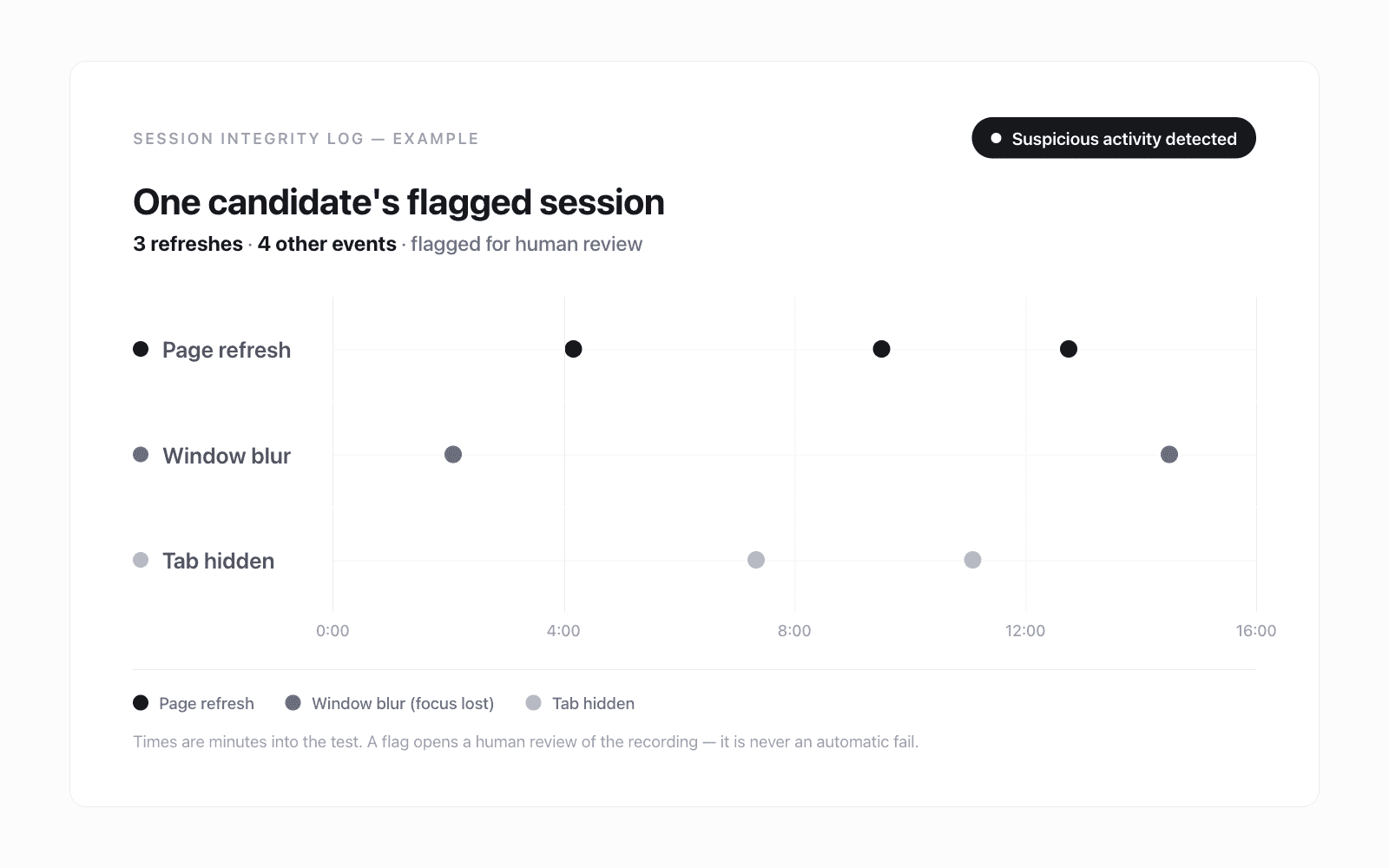
This is what protects honest candidates as much as it catches cheats. A nervous candidate who looks away is not a fraud. A system that treated them as one would be both unfair and impossible to defend. The point of the trail is simple: let a person make a fair decision with the full picture in front of them.
FAQ
Can you guarantee no candidate ever cheats? No, and be careful with anyone who promises that. The realistic goal is to make cheating harder and make attempts visible to a human reviewer. Layered detection plus a speaking format achieves this.
Why not just use webcam and screen proctoring? Because it is both beatable and legally risky. Studies show people can bypass proctoring. Regulators in the EU and courts in the US have ruled against invasive monitoring. We will add camera-based measures only when we can meet data-privacy standards.
Can't a candidate just use a second device or phone? They can try, but using one creates signs. In a speaking test, reading from a phone sounds unnatural. It also creates a consistent pause before each answer. A trained assessor notices both.
Do AI detectors catch ChatGPT answers? Not reliably. OpenAI removed its own detector because of low accuracy. Independent studies found that detectors falsely flag most non-native English writing. This is a core reason written assessments are weak, and spoken ones are not.
Won't honest candidates get falsely flagged? A single signal never fails a candidate. Flags must pass a threshold, and then a human reviews the recording in context. The system is designed to protect honest candidates, not punish nerves.
The short version
- No online assessment stops cheating 100%. Aim to increase the cost and make attempts visible — not to promise the impossible.
- Cheating is now common: 6% of candidates admit interview fraud, and 22% admit cheating on online assessments. AI raises scores while it hides from interviewers.
- "Cheat-proof" tools fail: people can bypass proctoring, and AI-text detectors are unreliable and biased against non-native writers.
- Each browser trick has an answer: we block second tabs, restart sections with fresh topics, track focus, send a 30-second heartbeat, and end the session on exit.
- Speaking gives you a built-in advantage: you cannot paste speech, reading aloud sounds unnatural, the pause before answering exposes the candidate, and a human hears AI phrasing live.
- Privacy-first is a feature: we add monitoring only when it is compliant — because monitoring you cannot defend is your liability, not your protection.
- Flags are evidence for a human, never an automatic verdict.
You cannot make cheating impossible. You can make it costly, visible, and far harder to hide — and a speaking assessment does more of that than any written test can.
By BEST · Product
- online assessment cheating
- assessment integrity
- remote interview cheating
- AI cheating in assessments
- speaking assessment
- remote hiring
- anti-cheating
- English speaking test
Keep reading
View all →
Product · 7 min read · Jun 19, 2026
Assess English presentation skills in the interview in 3 minutes
The more senior the role, the higher the stakes when they speak English. Why to measure presentational English in interviews, and a free tool to do it.
Product · 5 min read · May 25, 2026
Why English proficiency is not enough for senior job positions
A good score on an English proficiency test does not always mean good English at work.

Research · 12 min read · Jul 2, 2026
Spoken English is silently costing Hong Kong Companies millions
Poor spoken English quietly costs Hong Kong firms millions a year. See the hidden cost of poor English by industry, and how a senior examiner recovers most.